
In the winter of 1967, British speed visionary Donald Campbell took to Coniston Water in England’s Lake District with one goal in mind: to go faster than fast. Having already coaxed his jet-powered speedboat Bluebird to a staggering 310 miles per hour (500 km/h), he decided that one record-breaking run was simply not enough. He turned Bluebird around, opened the throttle, and thundered across the still surface of the lake.
Then, in an instant, calm turned to catastrophe. Without warning, Bluebird lifted, broke apart, and vanished into the depths. Campbell—who had spent his career chasing the very edge of possibility—was gone. His body would not be found for another thirty-four years.
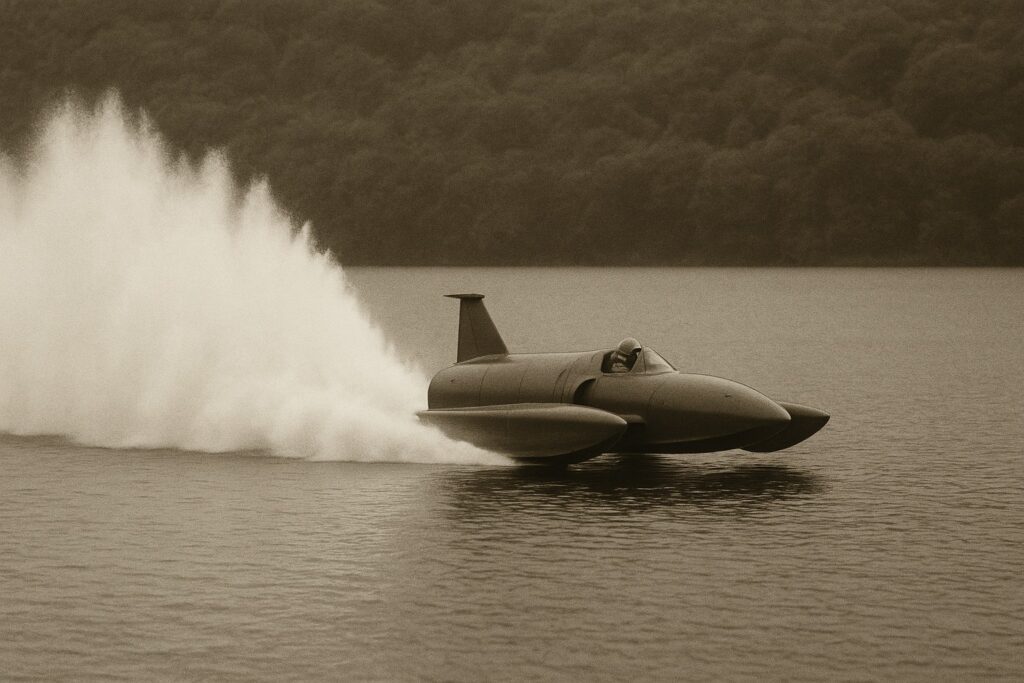
Campbell was no mere thrill-seeker; he was a knight of the modern age, one of those post-war figures who saw speed as the natural measure of progress. To go faster was to go forward. The hum of engines and the blur of motion became the soundtrack of modern life, and soon much of Western society had enrolled in what might be called the Cult of Acceleration.
But like all cults, this one had its price. The faster life became, the more it demanded of the human nervous system. What once felt exhilarating began to feel exhausting. Physicians of the day noted curious new afflictions—disorientation, scattered attention, anxiety, even a condition known as neurasthenia, a sort of existential fatigue brought on by too much modernity. The human mind, it seemed, was struggling to keep up with the machines it had made.
Observers began to suspect that something deeper was being lost: our sense of rhythm, our connection to the natural tempo of life. For thousands of years, we had lived by the gentle metronome of the seasons, the sun, and the body’s own pace. Now, we were syncing ourselves to clocks, engines, and eventually, screens. The world’s pulse had quickened, and we were racing to match it.
And perhaps we have adapted—after all, we can scroll, swipe, and multitask with dazzling efficiency—but the question lingers: what has this adaptation cost us?
Look around. Distraction hums like background noise. Fatigue has become a fashion. Anxiety, our most faithful companion, keeps pace beside us. We are, in every sense, creatures of speed—restless, efficient, and ever so slightly unmoored.
Speed is great, yes. Until, of course, it isn’t.