
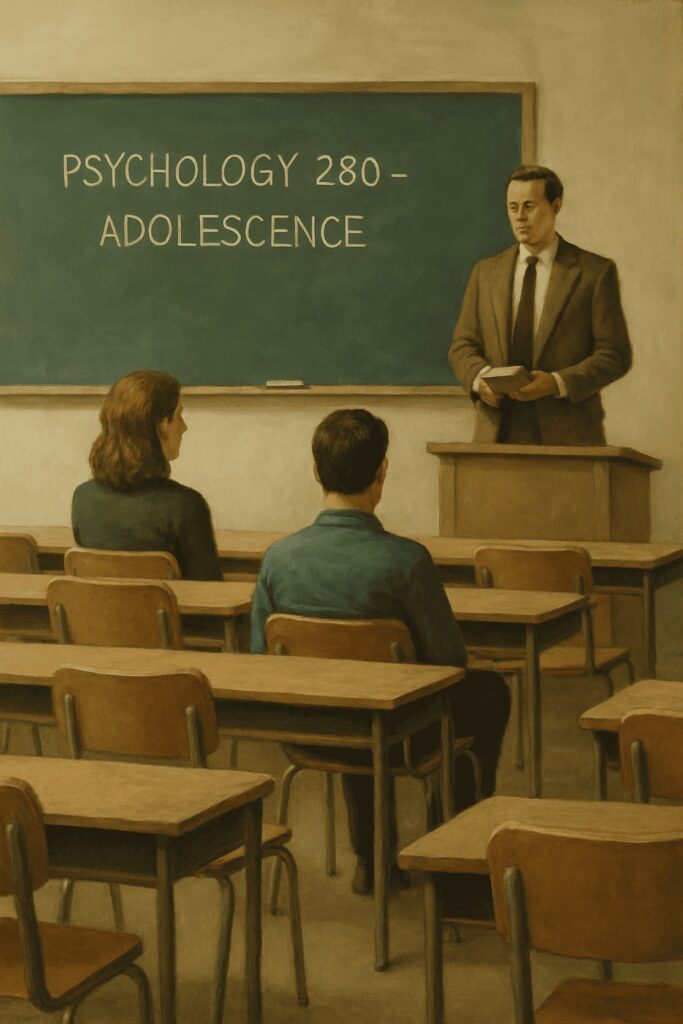
In the summer of 2006, I, along with about fifty other eager undergraduates, filed into a bright auditorium at Concordia University’s downtown campus in Montreal to begin Psychology 280 – Adolescence, a required course for would-be educators.
Looking back, I now see how this course managed to be both a spectacular failure and, in its own peculiar way, a resounding success.
Within a few short lectures, the initial buzz of anticipation began to fade. The lively hum of discussion gave way to a polite silence, and the once full lecture hall began to resemble a half-empty cinema on a Tuesday afternoon. Something vital had gone missing. The course felt oddly disconnected from the living, breathing world it claimed to study. Its detached, mechanical delivery, though efficient, seemed to drain both curiosity and joy from the subject.
What began as a vibrant group of adults, keen to explore the psychology of youth, gradually dissolved into a weary collection of credit-seekers, dutifully attending to the business of grades.
Psychology 280 – Adolescence was vertically integrated in every possible sense. From the customized textbook and machine-graded multiple-choice exams to the pre-set video modules and discussion questions — all neatly packaged and ready for consumption — the course was a model of modern efficiency. Everything fit together beautifully, like an educational assembly line.
And yet, something essential had slipped through the cracks.
In retrospect, both students and professor paid dearly for that efficiency. Learning had been trimmed, standardized, and costed. Education became a product to be delivered, measured, and consumed. The joy of discovery — that ineffable sense of enchantment that makes learning worthwhile — was quietly written out of the syllabus.

The course did, however, succeed in one notable regard: it was good for business. Standards were met, grades were high, and the machinery of the university turned smoothly. No one failed — at least not on paper.
Our professor, meanwhile, seemed less like an academic guide and more like a conscientious technician, administering knowledge in precise doses according to the manufacturer’s instructions. Whether he chose this role or was confined by it, we never knew.
But behind those tidy transcripts lay a quieter failure: one of imagination, of human connection, and of meaning. For when education becomes solely about efficiency and output, it risks losing the very thing that makes it transformative — the spark of curiosity, the enchantment of learning itself.