

At the heart of this entry is a hopeful wish — one I hold for children today and in the future. Quite simply, I wish that speed does not continue to devour slowness; that slow, timeless time in childhood is allowed the place it deserves.
Nowhere is the attack on childhood and a child’s eigenzeit (or own time) more vividly portrayed than in Michael Ende’s enchanting yet unsettling 1973 novel Momo. In the story, mysterious men in grey suits from the “Time Saving Bank” arrive in a quiet southern European city, bringing with them an icy chill and an unshakable belief that time must never be wasted. To them, unstructured time is suspect, and the sight of children “loafing around” the city is deeply troubling — not to mention inefficient.
For these men, time spent daydreaming, wandering, or doing things without a clear purpose is an abomination. A child with time on their hands is, after all, difficult to monitor — and impossible to mould into “an expert or technician of the future.” It doesn’t take long for the children to be rounded up and sent to new institutions called “child depots” — Ende’s darkly humorous stand-in for schools — where their days are filled with useful, measurable activities. Under watchful eyes, they play “functional games” with clear social value, like data retrieval, ensuring they become, in time, the efficient citizens the system so badly needs.
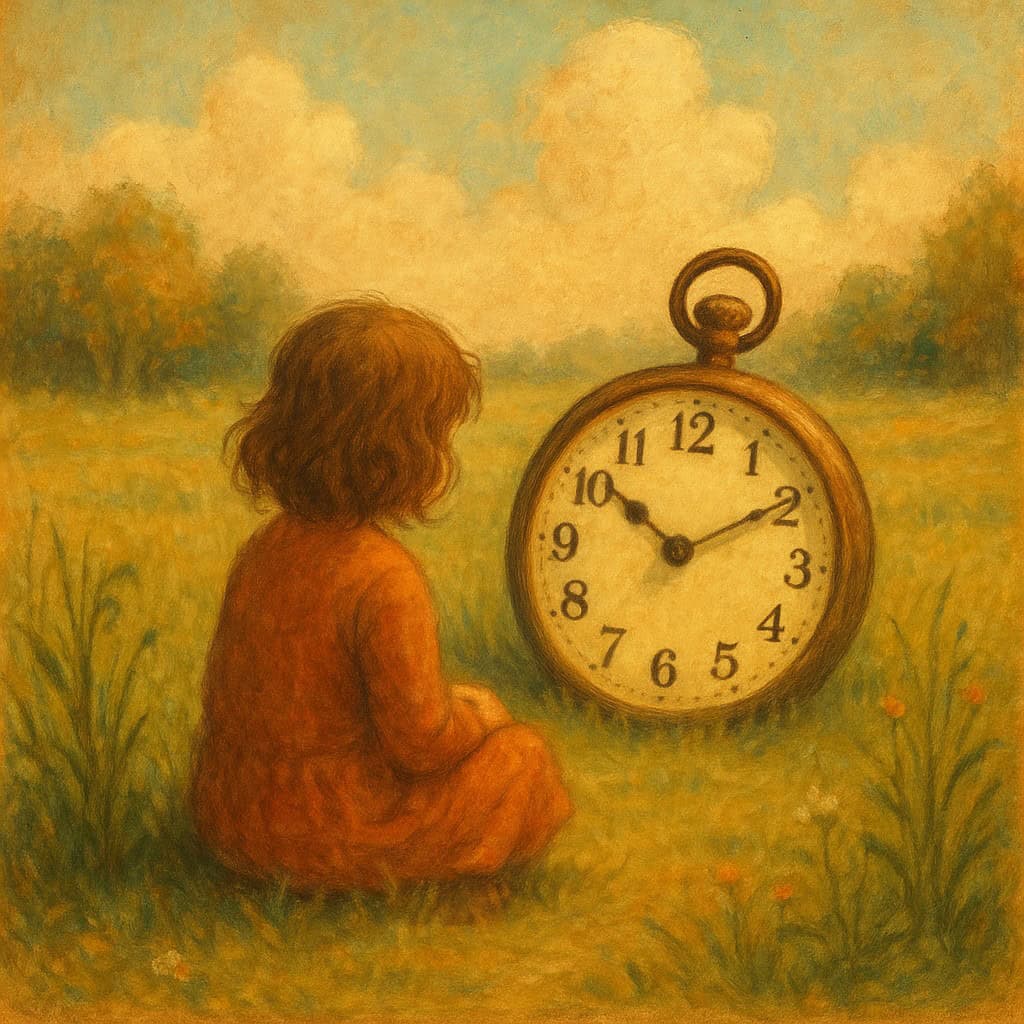
Ende’s story captures perfectly the machinery of what might be called temporal imperialism — the takeover of human time by rigid systems of control. In the process, the children’s imagination, curiosity, and sense of wonder quietly disappear.
More than fifty years later, Momo still feels like a timely reminder of how easily the management of time slips into the regulation of life itself. The men in grey may be fictional, but their legacy is everywhere: in our schedules, in our constant rush, in the quiet disappearance of slow moments. Meanwhile, children — the “morally wayward” ones who still know how to lose track of time — continue, in their own small ways, to resist. They remind us that vacant, unfilled time is not a flaw to be corrected but a luxury to be protected.